I'm about three weeks from sending my new novel COBALT BLUE back to my agent. I can tell the end is near because I'm shifting from mood to mood in a most unsettling way.
END-OF-NOVEL MOODS SO FAR:
*relief, as if I'd already finished
*fear that this finished book is going to make trouble for me one way or another *exhaustion that makes me feel tremulous with any emotion
*indecisiveness about small, unrelated things
*feebleness as if I'm starting to come out of an illness
*anger, that it hasn't already won the National Book Award, and that it still isn't quite finished
*uneasiness about the peculiarly erotic nature of this novel
*sadness that it will soon leave my hands
*pride that it's so good
*excitement about what will happen next
So mid-morning today, I lay down on the rug in front of my desk and slept for an hour. It was an excellent solution. It's 8 pm. and I've been balanced and productive ever since. Now I'm wrapping up for the day. And soon I will re-encounter my peculiar emotional state in my dreams, at least that's the way it was last night.
I'm telling myself to cherish these interestingly tumultuous times. At least I've given up fighting off the turmoil.
Monday, April 03, 2006


Friday, March 31, 2006
Billy Arthur: Small and Bold
"William J. "Billy" Arthur, well-known journalist, newspaper publisher, legislator, businessman and dwarf, died Monday, March 27, 2006 at Carolina Meadows Health Center."
This is the lead to an obit in the Raleigh News & Observer. A friend e-mailed it to me and said: you don't see many like this. The list of accomplishments is impressive and then you get to that last descriptor: dwarf.
In North Carolina, this man was A STATEWIDE PRESENCE, THOUGH HE WAS 42 INCHES TALL.
He didn't hide. He "went all out."
He was a politician. With his wife, he operated several businesses. And he wrote a newspaper column that ran for 66 years. He also sang on Broadway and was, in his youth, head cheerleader at UNC-Chapel Hill.
The friend who sent me the obit said her father remembered running into him on the street in the '40s and '50s and if you squatted down to talk with him, he would squat down too. "Just to keep things equal."
This is the lead to an obit in the Raleigh News & Observer. A friend e-mailed it to me and said: you don't see many like this. The list of accomplishments is impressive and then you get to that last descriptor: dwarf.
In North Carolina, this man was A STATEWIDE PRESENCE, THOUGH HE WAS 42 INCHES TALL.
He didn't hide. He "went all out."
He was a politician. With his wife, he operated several businesses. And he wrote a newspaper column that ran for 66 years. He also sang on Broadway and was, in his youth, head cheerleader at UNC-Chapel Hill.
The friend who sent me the obit said her father remembered running into him on the street in the '40s and '50s and if you squatted down to talk with him, he would squat down too. "Just to keep things equal."
Tuesday, March 28, 2006
A Wealth of Old Newspaper War Stories
One notable effect of a reunion of old newspaper people is that MOST EVERYONE LEAVES THE PARTY AND WRITES A STORY ABOUT IT.
The reunion at the new Raleigh Times Bar of staffers from the old Raleigh Times newspaper, which I've written about in the last few posts, has now turned into a print and cyberspace newsroom-nostalgia-fest.
Coming from a bunch of career writers, it's probably no surprise that the reminiscences make good stories: funny, poignant, and mostly well-written. Otherwise, the accounts are interestingly different from each other, and the coverage at the smaller newspapers is just as good as at the larger papers.
I've already linked to a couple of stories in previous posts. Here's A BRIEF RUNDOWN ON THE LATEST DISPATCHES:
At The Island Packet in Hilton Head, SC, David Lauderdale writes in both his blog and his column about the reunion: "Sharon Campbell remembers a reporter throwing a chair that whizzed right over her head. (Someone else recalled that) Dudley Price got tired of paper spilling over from the desk crammed next to his, so he set it on fire. With all the cigarette smoke in the room, it probably went unnoticed for hours."
David Lauderdale also quotes Arthur Sulzberger, now New York Times publisher, on his best and worst memories of his tenure at The Raleigh Times. The worst was when he called the home of a man and his son who had just been killed in a boating accident. The wife and mother answered, and Arthur learned that she hadn't yet been given the news.
Bob Ashley, now editor of The Herald-Sun in Durham started at The Raleigh Times the same week I did, both of fresh out of Duke, and both having worked for The Duke Chronicle. Bob notes how every detail of Raleigh was news for our staff; he once wrote eleven stories from one City Council meeting: no small morning's work.
Former Times editor A.C. Snow's column in the News & Observer remembers an angry call from a subscriber whose mother had been quoted all too correctly.
In The Apex Herald, Lynne Wogan conducts an interview with Gail Gregg, who was editor and the only writer of the Apex newspaper, then called the Western Wake Herald, while her husband Arthur, was working at the Raleigh Times. Apex was then a town of 3,000 and Gail, now a successful painter and freelance writer, was young, a self-described Yankee, ready to take on the world.
In the Clayton News-Star, editor Margaret Ritchie tells where a lot of old Times staffers are now, and says that what she has done with the newspaper in Clayton is recreate a paper a lot like the old Raleigh Times.
I'm still waiting for The Raleigh Times nostalgia piece to show up in The New York Times. Arthur, you're up.
The reunion at the new Raleigh Times Bar of staffers from the old Raleigh Times newspaper, which I've written about in the last few posts, has now turned into a print and cyberspace newsroom-nostalgia-fest.
Coming from a bunch of career writers, it's probably no surprise that the reminiscences make good stories: funny, poignant, and mostly well-written. Otherwise, the accounts are interestingly different from each other, and the coverage at the smaller newspapers is just as good as at the larger papers.
I've already linked to a couple of stories in previous posts. Here's A BRIEF RUNDOWN ON THE LATEST DISPATCHES:
At The Island Packet in Hilton Head, SC, David Lauderdale writes in both his blog and his column about the reunion: "Sharon Campbell remembers a reporter throwing a chair that whizzed right over her head. (Someone else recalled that) Dudley Price got tired of paper spilling over from the desk crammed next to his, so he set it on fire. With all the cigarette smoke in the room, it probably went unnoticed for hours."
David Lauderdale also quotes Arthur Sulzberger, now New York Times publisher, on his best and worst memories of his tenure at The Raleigh Times. The worst was when he called the home of a man and his son who had just been killed in a boating accident. The wife and mother answered, and Arthur learned that she hadn't yet been given the news.
Bob Ashley, now editor of The Herald-Sun in Durham started at The Raleigh Times the same week I did, both of fresh out of Duke, and both having worked for The Duke Chronicle. Bob notes how every detail of Raleigh was news for our staff; he once wrote eleven stories from one City Council meeting: no small morning's work.
Former Times editor A.C. Snow's column in the News & Observer remembers an angry call from a subscriber whose mother had been quoted all too correctly.
In The Apex Herald, Lynne Wogan conducts an interview with Gail Gregg, who was editor and the only writer of the Apex newspaper, then called the Western Wake Herald, while her husband Arthur, was working at the Raleigh Times. Apex was then a town of 3,000 and Gail, now a successful painter and freelance writer, was young, a self-described Yankee, ready to take on the world.
In the Clayton News-Star, editor Margaret Ritchie tells where a lot of old Times staffers are now, and says that what she has done with the newspaper in Clayton is recreate a paper a lot like the old Raleigh Times.
I'm still waiting for The Raleigh Times nostalgia piece to show up in The New York Times. Arthur, you're up.
Friday, March 24, 2006
More on Newspaper Buddies, Novelist Buddies
Here's another post from the recent reunion of people who worked for The Raleigh Times newspaper. In the previous post--where I told about this historic get-together of writers, editors, and photographers--I invited others to send in better pictures than mine. Well, a real photographer responded: these two vivid moments are from the camera of freelance photojournalist Karen Tam.
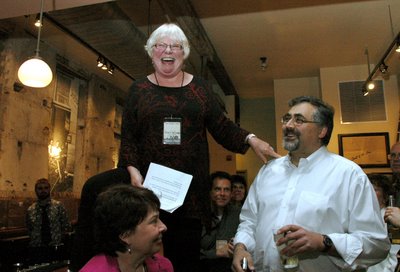
In this first, Sharon (Kilby) Campbell, retired editor of The Chapel Hill News is addressing the assemblage; with her are host and downtown redeveloper Greg Hatem (owner of The Raleigh Times Bar) and former Timeser Mary Burch, now executive director of a nonprofit, the Auditory Learning Center.
Lighting a celebratory cigar is Arthur Sulzberger, New York Times publisher, with News & Observer business writer Dudley Price inhaling.

These newspaper folks and I were covering Raleigh for the small and fiercely competitive Raleigh Times in the 1970s. Our being buddies helped us to do good work--after all, who would want to be the faltering member of the team?
I remember being part of the group that covered V.P. Spiro Agnew coming to town. My job was writing features from the hotel where he was staying, The Velvet Cloak. Security around the place was intense, and I was determined to find and interview his speech writer on this trip, a man I'm 97% sure was Daniel Patrick Moynihan.
I found out the room number and, coming out of the elevator, I scooted unseen past the back of the security guard. When he caught sight of me, I ran, heading around a corner and toward a door at the end of the balcony hallway.
I looked back only at the point when I was pounding on Moynihan's door. The guard was running toward me with his rifle held ready, as if he were advancing single-handedly on the whole Russian army.
The door opened. "A MAN IS FOLLOWING ME WITH A GUN," I said, appropriately breathless. The rather courtly Moynihan-most-likely ushered me in.
I was seated and near-composed by the time the guard got to the door. The White House advisor assured the man that all was well, not to worry.
He then, genially, gave me a few good quotes for my story, and I left him to his typewriter and his work-in-progress. The thing is: I don't know if I would have run down that hall without THE HONOR OF THE TEAM to uphold--or if I'd have stood in the bushes under one of the hotel's kitchen windows to interview people cooking for Agnew and his entourage.
MY NEWSPAPER BUDDIES FIRED ME UP TO DO MY BEST WORK then. Other "working" friendships, intensified by commitment to similar goals, help me do my best work as a novelist now. My office partner, and the fiction-writing critique group that I've been part of for 24 years, and other friends, including one from the old Times gang, all help me in this way. From them I get trustworthy criticism and encouragement, which is as important as any professional tool I have, and this includes my computer.
So--anybody got any more reunion pictures I can post? Or MORE WAR STORIES?
In the meantime, do go to the Times reunion coverage in the News and Observer written by columnist (and, as it happens, my sister-in-law) Ruth Sheehan, or to the report in The Independent by former Timeser Sylvia Adcock, who was later part of THE NEWSDAY TEAM that won the 1997 Pulitzer Prize for spot news reporting with their coverage of the TWA plane crash off Long Island.

In this first, Sharon (Kilby) Campbell, retired editor of The Chapel Hill News is addressing the assemblage; with her are host and downtown redeveloper Greg Hatem (owner of The Raleigh Times Bar) and former Timeser Mary Burch, now executive director of a nonprofit, the Auditory Learning Center.
Lighting a celebratory cigar is Arthur Sulzberger, New York Times publisher, with News & Observer business writer Dudley Price inhaling.

These newspaper folks and I were covering Raleigh for the small and fiercely competitive Raleigh Times in the 1970s. Our being buddies helped us to do good work--after all, who would want to be the faltering member of the team?
I remember being part of the group that covered V.P. Spiro Agnew coming to town. My job was writing features from the hotel where he was staying, The Velvet Cloak. Security around the place was intense, and I was determined to find and interview his speech writer on this trip, a man I'm 97% sure was Daniel Patrick Moynihan.
I found out the room number and, coming out of the elevator, I scooted unseen past the back of the security guard. When he caught sight of me, I ran, heading around a corner and toward a door at the end of the balcony hallway.
I looked back only at the point when I was pounding on Moynihan's door. The guard was running toward me with his rifle held ready, as if he were advancing single-handedly on the whole Russian army.
The door opened. "A MAN IS FOLLOWING ME WITH A GUN," I said, appropriately breathless. The rather courtly Moynihan-most-likely ushered me in.
I was seated and near-composed by the time the guard got to the door. The White House advisor assured the man that all was well, not to worry.
He then, genially, gave me a few good quotes for my story, and I left him to his typewriter and his work-in-progress. The thing is: I don't know if I would have run down that hall without THE HONOR OF THE TEAM to uphold--or if I'd have stood in the bushes under one of the hotel's kitchen windows to interview people cooking for Agnew and his entourage.
MY NEWSPAPER BUDDIES FIRED ME UP TO DO MY BEST WORK then. Other "working" friendships, intensified by commitment to similar goals, help me do my best work as a novelist now. My office partner, and the fiction-writing critique group that I've been part of for 24 years, and other friends, including one from the old Times gang, all help me in this way. From them I get trustworthy criticism and encouragement, which is as important as any professional tool I have, and this includes my computer.
So--anybody got any more reunion pictures I can post? Or MORE WAR STORIES?
In the meantime, do go to the Times reunion coverage in the News and Observer written by columnist (and, as it happens, my sister-in-law) Ruth Sheehan, or to the report in The Independent by former Timeser Sylvia Adcock, who was later part of THE NEWSDAY TEAM that won the 1997 Pulitzer Prize for spot news reporting with their coverage of the TWA plane crash off Long Island.
Monday, March 20, 2006
A Hundred Year-Old Writers' Group

Comrades-in-arts are crucial for writers, painters, and others working in fields that are often solitary and speculative. (I think I've said this a time or two before on this blog.)
Friday night I took part in A BANG-UP CELEBRATION of writer (and editor and photographer, etc.) SOLIDARITY that was so unusual--and terrific--that it drew a television crew, news reporters and people from New York to Florida.
The party was a gathering of "alums" of the now-defunct Raleigh Times. The invited guests included anyone who had ever worked for this little afternoon newspaper that was started just over a hundred years ago. The host was Greg Hatem, owner of the Raleigh Times Bar soon to open in the 1906 building that first housed the newspaper. The picture at the top of this post shows in the background the staff in the mid-70s.

This was not the first such gathering of Timesers--I've been to three other reunions. This is a bunch of people who have stayed in touch, stayed buddies even at a distance, and over so many years, so many decades.

I worked at this paper in 1970-1972--quite a while ago. The paper has been closed since '89. And yet, dozens of us still gather every few years. For any kind of enterprise, this is some unusual solidarity.
This tight connection came about because we were such a scrappy little newspaper. There were probably no more than 8 or 10 reporters in the newsroom at a time, and we competed daily against the magnitudes-larger News & Observer.
The work was intense. My beat was health, science, the environment and education, and that was the year the schools here desegregated. Busy? Whoa, baby!
When I first interviewed for the job, the managing editor Joe Harper asked if I was comfortable writing up to five stories a day; I assured him I was, though I doubt if I ever had done any such thing. We wrote for two deadlines, 9:30 a.m. and 12:30 p.m. Then we went to lunch together. Supposedly, we were off work at three.
The group was typically young and single. So people partied together, romanced, shared apartments, as well as working together.
Now those of us who worked there are bonded. Permanently. Sort of like we were underdogs together in the same battle.
And people have turned out pretty well so far: among those attending were a reporter from the St. Petersburg paper, an art gallery owner, several successful freelancers, an antiques dealer, a couple of painters, a journalism professor, a media consultant, the editor of The Durham Herald-Sun and the publisher of The New York Times. Those who had to miss this time include: an editor at The Washington Post, and the just-retired head of a university journalism school.
Karen Tam, a photographer, staged her slide show of "how-we-were" in the '70's--always a hilarious and poignant event at these reunions. The media consultant and I were an item in one of those "hippie" years; there he was in dashiki in one of the old pictures, with me in my pink velour bell bottoms.
A regular highlight of the slide show: a guy who is now a reporter for the News & Observer was literally caught with his pants down on some unnamed social occasion; it was a moment he will never be allowed to forget.
Also portrayed were various members of the gang: climbing a tree, playing at the beach, working in the newsroom, making faces, showing off a new baby, etc. That baby is an adult now. The rest of us are adults-and-then-some.
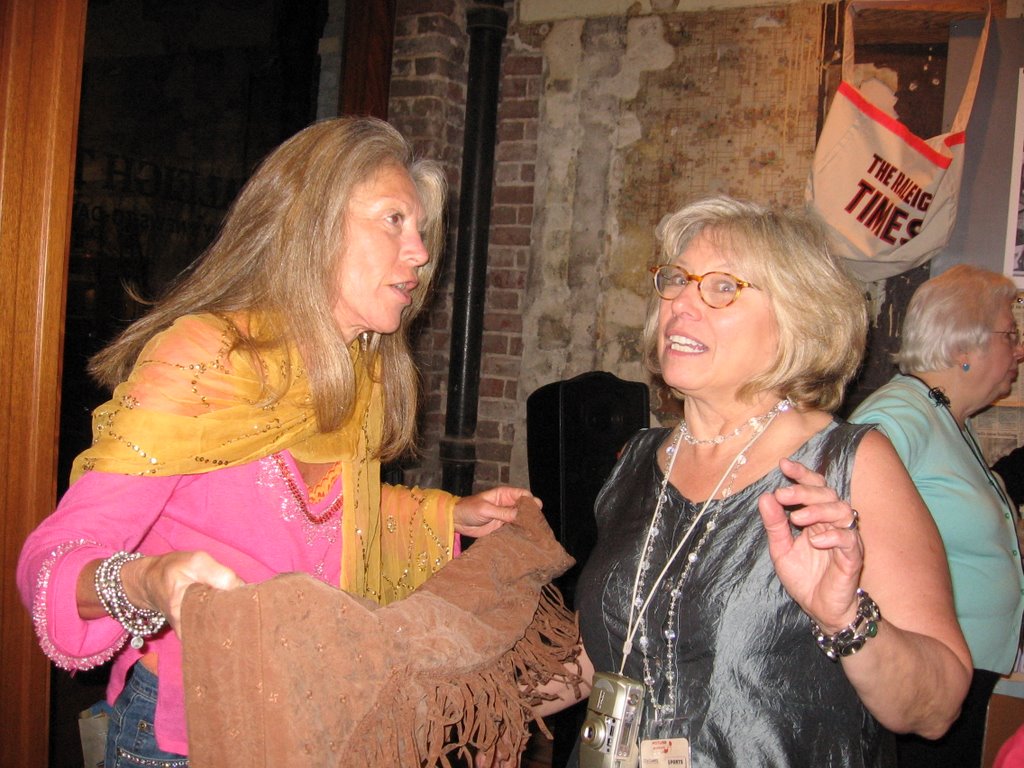
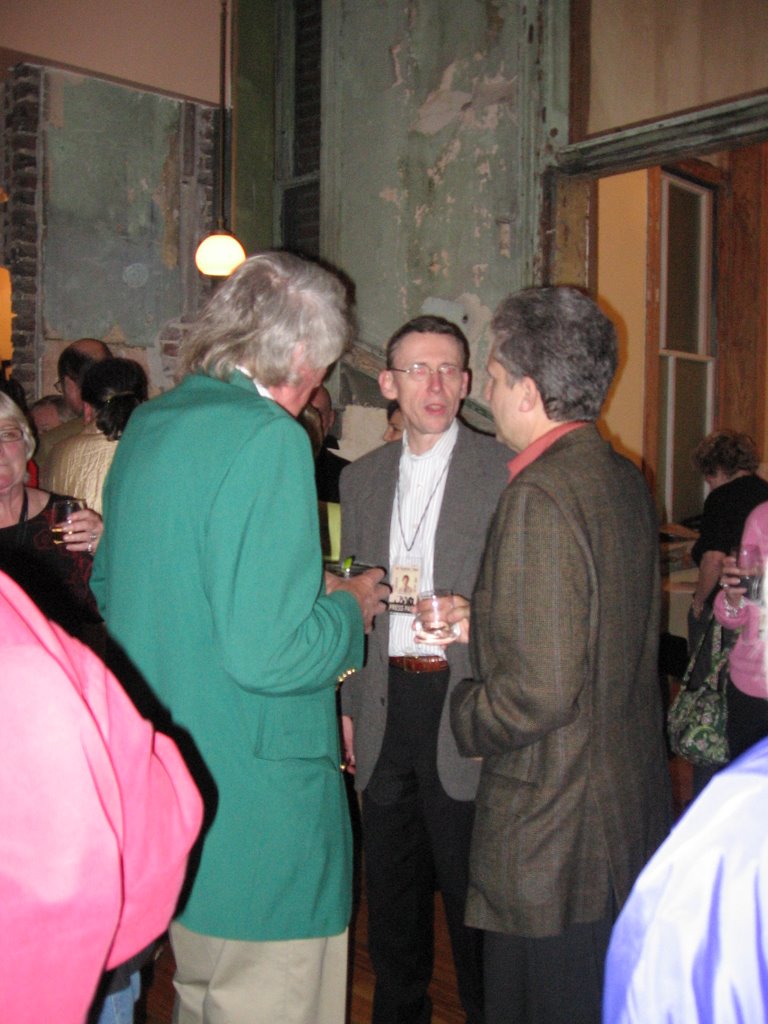
As you see, I tried shooting a few pictures at Friday's party. They didn't turn out very well. All the people are much more fetching than these pix would indicate. (I held back the real howlers, maybe they'll be in the next slide show.) New camera, low light, fit of shyness, dying batteries, and good conversations got in the way. But here are a few of them. If you happened to be at that party and have better ones, email me (ppayne51@cs.com) and I'll post those.
Again, let me say: it's a great thing to have such friends.
Thursday, March 16, 2006
An Invitation to Promote Your Art
A lot of blogs ask people who comment to refrain from writing anything self-promotional.
I'm taking the opposite approach. I'd like to invite you to use this space to PROMOTE YOUR CREATIVE WORK. If you have a book coming out, or an art opening, a dazzling new invention, or a class or speaker to assist people in doing this kind of work: ANNOUNCE IT HERE.
Doesn't matter where you are. Even if readers can't get to the show, they can still learn where to find you and your work.
So if you have a product that you, as an individual, created, HAVE AT IT. Say, in the comments section of any one post, regardless of the post topic, what you've got going on--unless what you created is Viagra.
I'm taking the opposite approach. I'd like to invite you to use this space to PROMOTE YOUR CREATIVE WORK. If you have a book coming out, or an art opening, a dazzling new invention, or a class or speaker to assist people in doing this kind of work: ANNOUNCE IT HERE.
Doesn't matter where you are. Even if readers can't get to the show, they can still learn where to find you and your work.
So if you have a product that you, as an individual, created, HAVE AT IT. Say, in the comments section of any one post, regardless of the post topic, what you've got going on--unless what you created is Viagra.
Wednesday, March 15, 2006
City of Literature
From the blog The Elegant Variation:
THERE GOES THE NEIGHBORHOOD
As part of its City of Literature push, Edinburgh would like to become a "city of refuge" for persecuted writers.
The Scottish capital could offer sanctuary to those unable to work and live safely in their home country.
If senior councillors give the proposal their backing on Tuesday, the Lord Provost Lesley Hinds will launch a consultation on the move.
Edinburgh would then look to bid for official status, aiming to be accepted in time for this year's book festival.
The idea has been brought forward by the Scottish branch of PEN, a worldwide association of writers committed to protecting freedom of expression.
Note from Peggy: I applaud the idea of a City of Literature. May all our villages have such aspirations.
THERE GOES THE NEIGHBORHOOD
As part of its City of Literature push, Edinburgh would like to become a "city of refuge" for persecuted writers.
The Scottish capital could offer sanctuary to those unable to work and live safely in their home country.
If senior councillors give the proposal their backing on Tuesday, the Lord Provost Lesley Hinds will launch a consultation on the move.
Edinburgh would then look to bid for official status, aiming to be accepted in time for this year's book festival.
The idea has been brought forward by the Scottish branch of PEN, a worldwide association of writers committed to protecting freedom of expression.
Note from Peggy: I applaud the idea of a City of Literature. May all our villages have such aspirations.
Tuesday, March 14, 2006
Social Support for Artists
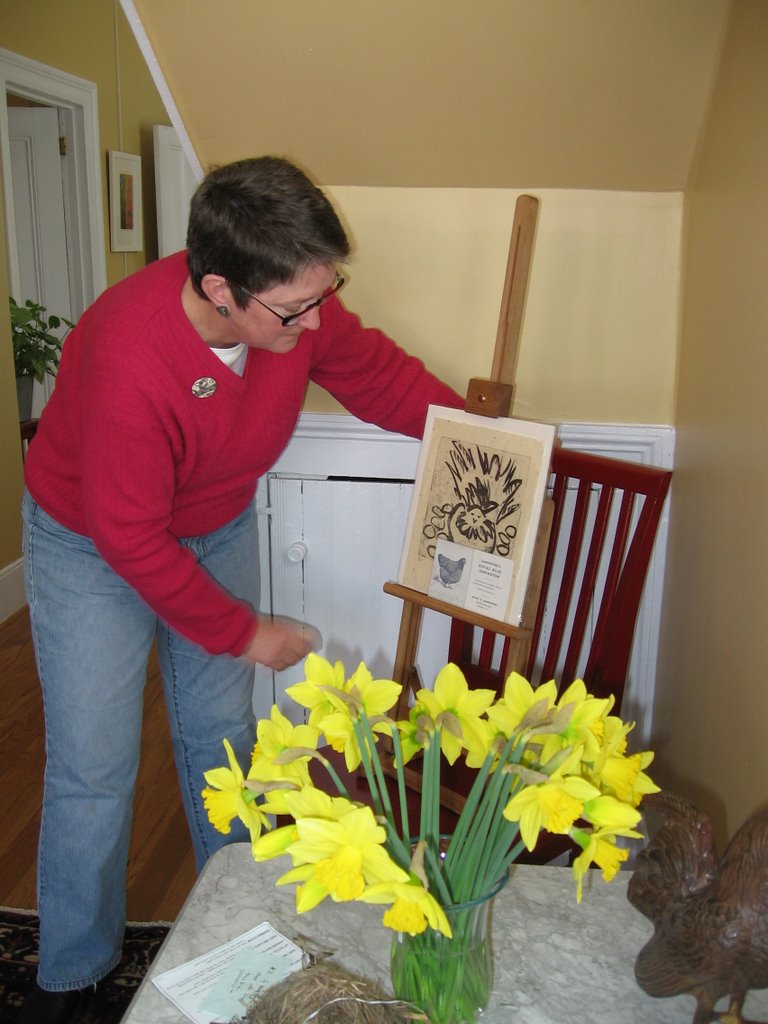
One of the best things I've ever done for my daily productivity as a writer is move my office into my good buddy Carrie's office building. That's her, just to the right--Carrie Knowles, both a printmaker and writer (The Last Childhood, Three Rivers, 2000.)
My office and hers are situated so that, with doors open, we can talk without either of us getting up from our desks. Or if we need quiet (hasn't happened yet) or have a client, then we can shut the doors.
Her visual art space--Free Range Studio and Gallery--is in the front room and in the big old-fashioned foyer of this 1910 house. In the picture she's setting up a piece of art just inside the front door.
So, not only do I get to my office through a small charming gallery, but she and I have an ongoing conversation as well as trading advice throughout the day. My question this morning: can I use the word "disingenuous" and not have to explain it?
More important than the advice is being able to have two minutes of conversation most any time. For a person who works in solitude, this is so valuable, because:
*The frustrations of the work are less frustrating.
*Work is more fun, and I keep going longer.
*Looking at her artworks in progress refreshes my mind.
*I have the sense that my daily work problems are shared and they are less serious than they otherwise would be.
*If I'm about to shoot myself in the foot by, for example, agreeing to a price or timeline that I shouldn't, she can see it more clearly in the moment than I can.
*I take five-minute breaks in the building, instead of the 30-minute go-somewhere kind that I would otherwise.
*And again, it's just fun.
Even if you sit and write together at a fast-food restaurant, it can be helpful to have a writing buddy.
Monday, March 13, 2006
Post-Deadline Euphoria
I shipped the big editing project, caught up on sleep, and today I am as light as pollen. (It's warmy and breezy spring here today.)
It's a delicious feeling, to have just gotten a huge amount of work done. Back when I worked for The Raleigh Times--a now-defunct afternoon newspaper, and my first job after graduation--I had this feeling many days. Because the work I did in the morning was in the paper in the afternoon. Not many kinds of work give that immediate relief, celebration and feedback. Writing novels certainly doesn't.
I find it nice--no, more than that--to have this feeling periodically. Like the pollen, I'm pure potential (a rare feeling in adult life.) And like the pollen, today I'm just drifting on the breeze.
That's crucial before re-immersing myself in the details of work.
Once in my 20s, I finished a batch of stories for Family Circle magazine and felt, not light, but so burned-out I couldn't imagine lifting a finger to a keyboard again. The day that work was done, I decided I was going to Mexico the next day. By myself. No reservations, no definite return date. And I told the editor that I couldn't be reached. I wound up in Isla Mujeres, "the island of women." I slept a mere 20 hours my first day there, and when I finally emerged from the room, I found someone had put flowers around my door.
I stayed a week, rode a bike around the island, snorkelled, ate, improbably, in a French restaurant on a porch. The woman who owned the place came out and sat down with me and said her 30 year-old son was coming in from Paris that afternoon. Would I have dinner with him? A blind date set up by the guy's mother. I was flattered, sort of. I don't think he was, though. He seemed jet-lagged and irritable mainly, but we got through dinner.
I came home from that trip feeling good. But it only lasted a few days. It became clear to me then that I was facing some decisions about career direction. I think it took that interim, and it's not "working," to help me see. So I'm in favor of time off, sometimes taken grudgingly, whether it feels good or not.
Today it feels good. Now I shut down my computer and go outside and play.
It's a delicious feeling, to have just gotten a huge amount of work done. Back when I worked for The Raleigh Times--a now-defunct afternoon newspaper, and my first job after graduation--I had this feeling many days. Because the work I did in the morning was in the paper in the afternoon. Not many kinds of work give that immediate relief, celebration and feedback. Writing novels certainly doesn't.
I find it nice--no, more than that--to have this feeling periodically. Like the pollen, I'm pure potential (a rare feeling in adult life.) And like the pollen, today I'm just drifting on the breeze.
That's crucial before re-immersing myself in the details of work.
Once in my 20s, I finished a batch of stories for Family Circle magazine and felt, not light, but so burned-out I couldn't imagine lifting a finger to a keyboard again. The day that work was done, I decided I was going to Mexico the next day. By myself. No reservations, no definite return date. And I told the editor that I couldn't be reached. I wound up in Isla Mujeres, "the island of women." I slept a mere 20 hours my first day there, and when I finally emerged from the room, I found someone had put flowers around my door.
I stayed a week, rode a bike around the island, snorkelled, ate, improbably, in a French restaurant on a porch. The woman who owned the place came out and sat down with me and said her 30 year-old son was coming in from Paris that afternoon. Would I have dinner with him? A blind date set up by the guy's mother. I was flattered, sort of. I don't think he was, though. He seemed jet-lagged and irritable mainly, but we got through dinner.
I came home from that trip feeling good. But it only lasted a few days. It became clear to me then that I was facing some decisions about career direction. I think it took that interim, and it's not "working," to help me see. So I'm in favor of time off, sometimes taken grudgingly, whether it feels good or not.
Today it feels good. Now I shut down my computer and go outside and play.
Thursday, March 09, 2006
My First All-Nighter
Last night gives new meaning to the cliche: it's never too late.
At the age of 57, I did my first all-nighter--a rough deadline on an editing project. I worked straight through the night and now it's 3 o'clock in the afternoon, and I'm about to leave the office and call it A DAY.
I'm pleased with the work. And feel proud,as if I held up reasonably well in some athletic competition like a triathlon. Hour after hour--kept pawing at the keyboard and after a while the sun started coming up. Just wanted to share this moment with you.
At the age of 57, I did my first all-nighter--a rough deadline on an editing project. I worked straight through the night and now it's 3 o'clock in the afternoon, and I'm about to leave the office and call it A DAY.
I'm pleased with the work. And feel proud,as if I held up reasonably well in some athletic competition like a triathlon. Hour after hour--kept pawing at the keyboard and after a while the sun started coming up. Just wanted to share this moment with you.
Monday, March 06, 2006
Inspiration from the Oscars
Watching the Academy Awards--an annual event of great importance for me--offers every year TWO KINDS OF INSPIRATION. The show flamboyantly demonstrates that:
1. Dreams do come true, in a huge way, and sometimes for people who didn't seem to have a chance from the start.
2. Even wildly successful people still have big disappointments that they cope with and then keep on working.
This year there was AN INSPIRATIONAL BONUS: the Coke ad campaign. One of the slogans was (something on the order of): "Live Life As If They're Wanting an Encore."
Imagine that. Literally. Not only does the audience love your song, they want you to sing another one. That's inspiring. That kind of thinking can keep you singing.
1. Dreams do come true, in a huge way, and sometimes for people who didn't seem to have a chance from the start.
2. Even wildly successful people still have big disappointments that they cope with and then keep on working.
This year there was AN INSPIRATIONAL BONUS: the Coke ad campaign. One of the slogans was (something on the order of): "Live Life As If They're Wanting an Encore."
Imagine that. Literally. Not only does the audience love your song, they want you to sing another one. That's inspiring. That kind of thinking can keep you singing.
Monday, February 27, 2006
Ferociously Busy
Finished the latest draft of my new novel COBALT BLUE. And working nearly continuously (though I do sleep and eat) to get a line-edit done ASAP of another writer's novel. Wow!
At the same time, "literary lightning," a great rush of wonderful book-luck hit a friend of mine in the past week. So I took a multi-hour break to celebrate. She doesn't want her name used yet, because she's superstitious and feels it's too soon to talk about. But I think most of the nation will hear at some point not too far away.
And I want to highly recommend another excellent book, just out from a good buddy. Have a look at Dan Wakefield's THE HIGHJACKING OF JESUS. It tells exactly how the fundamentalist right-wing movement has used churches as a political base. Pretty juicy. You can click to Dan's website from my links list.
More later when the smoke clears.
At the same time, "literary lightning," a great rush of wonderful book-luck hit a friend of mine in the past week. So I took a multi-hour break to celebrate. She doesn't want her name used yet, because she's superstitious and feels it's too soon to talk about. But I think most of the nation will hear at some point not too far away.
And I want to highly recommend another excellent book, just out from a good buddy. Have a look at Dan Wakefield's THE HIGHJACKING OF JESUS. It tells exactly how the fundamentalist right-wing movement has used churches as a political base. Pretty juicy. You can click to Dan's website from my links list.
More later when the smoke clears.
Friday, February 17, 2006
"Literary Lightning"
You know those stories about megamillion-dollar literary luck? My local newspaper (The News & Observer in Raleigh) just ran a piece on the luck involved in huge success. It's about one author who has just been struck by "literary lightning" and about me, as an example of a writer who has had good luck, but not the million dollar kind.
As you can imagine, I was a little nervous about being an interviewed for an article where I could come off as the "designated loser," the one that luck was ignoring.
But the reporter, Bridgette Lacy, is a very good one, and a novelist herself. And as my husband reminded me "all publicity is good publicity." So I went ahead. And I was very pleased with the results. It felt like a kind of public wish for my good luck, for which I'm grateful.
If anybody has any ideas about how to bring on this kind of luck, do pass them on.
As you can imagine, I was a little nervous about being an interviewed for an article where I could come off as the "designated loser," the one that luck was ignoring.
But the reporter, Bridgette Lacy, is a very good one, and a novelist herself. And as my husband reminded me "all publicity is good publicity." So I went ahead. And I was very pleased with the results. It felt like a kind of public wish for my good luck, for which I'm grateful.
If anybody has any ideas about how to bring on this kind of luck, do pass them on.
Monday, February 13, 2006
New from Anna Deavere Smith
Just heard on my local Shaw University radio station: an intriguing interview with actor-writer Anna Deavere Smith. Her new book Letters to a Young Artist has been out three weeks and sounds like the sort of thing we'd be interested in.
Sounds terrific, in fact, whether or not the artist is experienced or young. (Of course the practice of an art does keep a person young.)
The subtitle is Straight-up Advice on Making a Life in the Arts-For Actors, Performers, Writers, and Artists of Every Kind and the reviews are good.
The author is seriously smart and also very wide-ranging in her view of art--includes advice from a rodeo rider and a dentist. This point-of-view about art is, I think, good for writers and good for dentists.
Sounds terrific, in fact, whether or not the artist is experienced or young. (Of course the practice of an art does keep a person young.)
The subtitle is Straight-up Advice on Making a Life in the Arts-For Actors, Performers, Writers, and Artists of Every Kind and the reviews are good.
The author is seriously smart and also very wide-ranging in her view of art--includes advice from a rodeo rider and a dentist. This point-of-view about art is, I think, good for writers and good for dentists.
Wednesday, February 08, 2006
Use The Promotional Resources You Have
My writer/artist-buddy Carrie Knowles brought into the office last night a tantalizing book Lost Secrets of the Sacred Ark that because of my metaphysical interest she thought I'd like.

Glancing over the flap copy I paused at this bit in the writer's bio: The author Laurence Gardner is "a Knight Templar of St. Anthony and Prior of Sacred Kindred of St. Columba." Moreover, at least one of his books has been a bestseller. I'm thinking maybe there's a connection
SO WHY HAVE I BEEN IGNORING MY OWN ESOTERIC CREDENTIALS, since my novels are all mystical adventures?
Here is my tenuous connection--based on my internet research--and you may well see this info noted on my next dust jacket.
My name Payne is a variation on the name Payen, etc. It comes from the word "pagan" and originally referred not to a family group but to the people in the British Isles who hid out in the boondocks (le pays) when the Romans arrived. These were the folks who didn't like being taken over and organized. So it's no wonder that I and most of my relatives are bull-headed, given to flights of fancy, and self-employed.
NOW HERE'S THE HEADLINE ITEM: The first recorded use of the name for a particular individual was Hugh de Payen (sometimes written Payens or Pagen)who was FOUNDER OF THE KNIGHTS TEMPLAR
Not that I've tracked down any kinship to Sir Hugh.
Nonetheless, I mean to mention this name thing prominently when COBALT BLUE comes out. Seriously. I think the Knights Templar founder will CONNECT me with readers who would like my work.

Glancing over the flap copy I paused at this bit in the writer's bio: The author Laurence Gardner is "a Knight Templar of St. Anthony and Prior of Sacred Kindred of St. Columba." Moreover, at least one of his books has been a bestseller. I'm thinking maybe there's a connection
SO WHY HAVE I BEEN IGNORING MY OWN ESOTERIC CREDENTIALS, since my novels are all mystical adventures?
Here is my tenuous connection--based on my internet research--and you may well see this info noted on my next dust jacket.
My name Payne is a variation on the name Payen, etc. It comes from the word "pagan" and originally referred not to a family group but to the people in the British Isles who hid out in the boondocks (le pays) when the Romans arrived. These were the folks who didn't like being taken over and organized. So it's no wonder that I and most of my relatives are bull-headed, given to flights of fancy, and self-employed.
NOW HERE'S THE HEADLINE ITEM: The first recorded use of the name for a particular individual was Hugh de Payen (sometimes written Payens or Pagen)who was FOUNDER OF THE KNIGHTS TEMPLAR
Not that I've tracked down any kinship to Sir Hugh.
Nonetheless, I mean to mention this name thing prominently when COBALT BLUE comes out. Seriously. I think the Knights Templar founder will CONNECT me with readers who would like my work.
Monday, February 06, 2006
Writer's Block
Here's a good NPR show on writer's block and some ways to deal with it from the series "The Infinite Mind."
One of the most useful parts of the show is the quotes from writers like FLAUBERT, CONRAD, DANTE, etc. talking about their problems with blocking. It's encouraging to know that they had this problem and managed to do pretty well anyway.
Then there's best-selling satirist Fran Lebowitz, who could put most writers' writer's block problems into perspective: she had a multi-year phobia of going into the room where her desk sat.
For me, the songwriter Aimee Mann was the MOST USEFUL. One of her ideas for solving the problem is to write out how you're feeling. She wrote a song about "calling it quits" that got her to writing songs again.
One of the most useful parts of the show is the quotes from writers like FLAUBERT, CONRAD, DANTE, etc. talking about their problems with blocking. It's encouraging to know that they had this problem and managed to do pretty well anyway.
Then there's best-selling satirist Fran Lebowitz, who could put most writers' writer's block problems into perspective: she had a multi-year phobia of going into the room where her desk sat.
For me, the songwriter Aimee Mann was the MOST USEFUL. One of her ideas for solving the problem is to write out how you're feeling. She wrote a song about "calling it quits" that got her to writing songs again.
Friday, February 03, 2006
"Living Out Loud"

My husband Bob who turns 64 tomorrow received the unlikely birthday gift of two tickets to Menopause: The Musical, which is now on a many-city national tour.
And what a burst of boldness this show is!
(It may seem an odd present for a man. But it's something any married man should see at some point. Also, Bob's a psychotherapist and deals with menopause issues in his practice.
So we went to this musical. And loved it, both of us.
WHAT AN UPPER!!! it is.
Four women--Iowa Housewife, Soap Star, Power Woman, and Earth Mother-- sing Boomer rock-and-roll songs with the words hilariously changed to such subjects as sex and hot flashes.
Essentially it's about the solidarity between women who are going through the sweaty, tumultuous experience of estrogen loss, who bond with an intensity like men's war friendships.
And it's about "living out loud," being bold. From the writer Emile Zola: "If you ask me what I came to do in this world, I will answer--I CAME HERE TO LIVE OUT LOUD."
Each of the four women gives a fine performance. And when Power Woman, who is rather large, emerges at the end in a slinky little black dress and a lion-sized Tina Turner mane, the result in the crowd is a rush of giddiness, not unlike the moment when a gulp of champagne goes straight to the brainstem.
At the end of the performance, the entire audience was invited to the stage to join in the final kick line.
For anyone wanting to live with more intensity, daring, and authenticity, this is a delightful encouragement. And it's as much fun as any show I've ever seen.
Thanks for the tix, Ruth and Harry and sons.
(Lately this blog has become my thank-you notes. I guess there's nothing wrong with "thank you" writ large.)
Monday, January 30, 2006
The Gift of Boldness
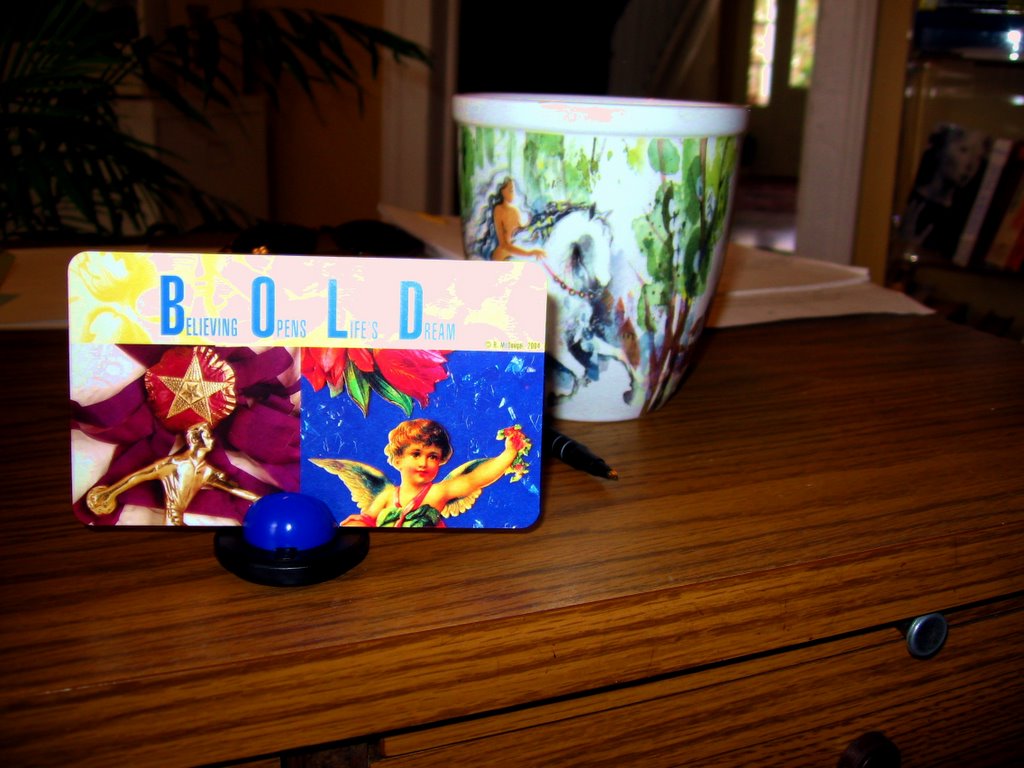
I've decorated my desk with a couple of birthday presents I recently received in celebration of my turning 57.
One was a set of inspirational cards, (Isle of View Insight Cards). Next to my computer today is the one that plays off the word BOLD. The letters of the word are a reminder of the message: Believing Opens Life's Dream.
The idea, of course, is: BELIEVE YOU CAN ACHIEVE WHAT YOU WANT AND YOU'LL BE ABLE TO.. I do believe that and I have, pretty much, found it to be so (although the jury's still out on a couple of matters). Much as I believe it, I also find it helpful to be reminded.
Then there's the Lady Godiva cup, which holds enough to feed Lady Godiva's horse, and came with some sumptuous Godiva cocoa. The image--of the naked woman on the horse--also brought along its thousand year-old history: Lady Godiva bared all in order to achieve her purpose.
What she wanted was for her husband, the Earl of Leofric, to lower taxes on the peasantry. He said he'd do it the day she rode through town naked. So she did.
What artists must summon again and again is the courage be as EMOTIONALLY BARE IN OUR WORK AS LADY GODIVA.
So I'm drinking deep out of this mug; of course the chocolate helps too.
And thank you, Joe Burgo and Karen Tam.
Friday, January 20, 2006
From Robertson Davies
Davies is one of my long-time favorite novelists, especially The Deptford Trilogy. His Jungian tilt intrigues me. Nobody does archetypes better.
Here's a thought from him that I found encouraging--especially for when a manuscript is at its muddy stage.
The best among our writers are doing their accustomed work of mirroring what is deep in the spirit of our time; if chaos appears in those mirrors, we must have faith that in the future, as always in the past, that chaos will slowly reveal itself as a new aspect of order.
Robertson Davies
A Voice from the Attic (1951)
The way I think about this is personal: "what is deep in my spirit" rather than what's in the spirit of our time. Often it's something I don't know about, and am shocked to find. Also, I don't try to "mirror" it. Instead I use it as a spark of energy that will start to lead me into a fictional story.
I chase the spark, do my best to keep it in sight.
ADDENDUM: Adapting bits of wisdom to suit me is necessary. A writer friend told me this definition of a writer: someone who, if present as God creates the universe, would stare at the final product then say, You know, God, it's nice, but it would be so much better if you just changed this...." I expect that definition applies pretty well to most humans.
Here's a thought from him that I found encouraging--especially for when a manuscript is at its muddy stage.
The best among our writers are doing their accustomed work of mirroring what is deep in the spirit of our time; if chaos appears in those mirrors, we must have faith that in the future, as always in the past, that chaos will slowly reveal itself as a new aspect of order.
Robertson Davies
A Voice from the Attic (1951)
The way I think about this is personal: "what is deep in my spirit" rather than what's in the spirit of our time. Often it's something I don't know about, and am shocked to find. Also, I don't try to "mirror" it. Instead I use it as a spark of energy that will start to lead me into a fictional story.
I chase the spark, do my best to keep it in sight.
ADDENDUM: Adapting bits of wisdom to suit me is necessary. A writer friend told me this definition of a writer: someone who, if present as God creates the universe, would stare at the final product then say, You know, God, it's nice, but it would be so much better if you just changed this...." I expect that definition applies pretty well to most humans.
Wednesday, January 18, 2006
Rejection Slip
Only one post ago, I was blythely writing about how we have to consider rejections, obstacles, setbacks as progress. Since it's inevitable that some come along, we just need to view them as part of the trip, not a reason to stop or slow down.
And then-- a favorite client of mine decided to cancel the project I'd already gotten deeply involved in. I'd written one draft of a booklet, a piece I'm especially proud of. Now: no booklet.
I got paid anyway, very well-treated. No hard feelings from me, and none from them that I know of.
Yet--that piece I like so much will likely never be read.
Indeed, A DISAPPOINTMENT.
I looked back ruefully on what I'd just so easily written about absorbing these blows. Well, the thing is I NEVER SAID THEY'RE NOT BLOWS.. The news hovered at the edge of my consciousness, like a pulled muscle, until mid-day the following day. I kept working, I'm proud to say.
Now once again I feel philosophical about the parts of this work I cannot control. I still wish, though, that that 20-pager was going to be published.
And I'm genuinely pleased to discover again that I still possess my RESILIENCE.
And then-- a favorite client of mine decided to cancel the project I'd already gotten deeply involved in. I'd written one draft of a booklet, a piece I'm especially proud of. Now: no booklet.
I got paid anyway, very well-treated. No hard feelings from me, and none from them that I know of.
Yet--that piece I like so much will likely never be read.
Indeed, A DISAPPOINTMENT.
I looked back ruefully on what I'd just so easily written about absorbing these blows. Well, the thing is I NEVER SAID THEY'RE NOT BLOWS.. The news hovered at the edge of my consciousness, like a pulled muscle, until mid-day the following day. I kept working, I'm proud to say.
Now once again I feel philosophical about the parts of this work I cannot control. I still wish, though, that that 20-pager was going to be published.
And I'm genuinely pleased to discover again that I still possess my RESILIENCE.
Subscribe to:
Posts (Atom)


